Single Boiler vs Dual Boiler Espresso Machines: What’s the Difference?
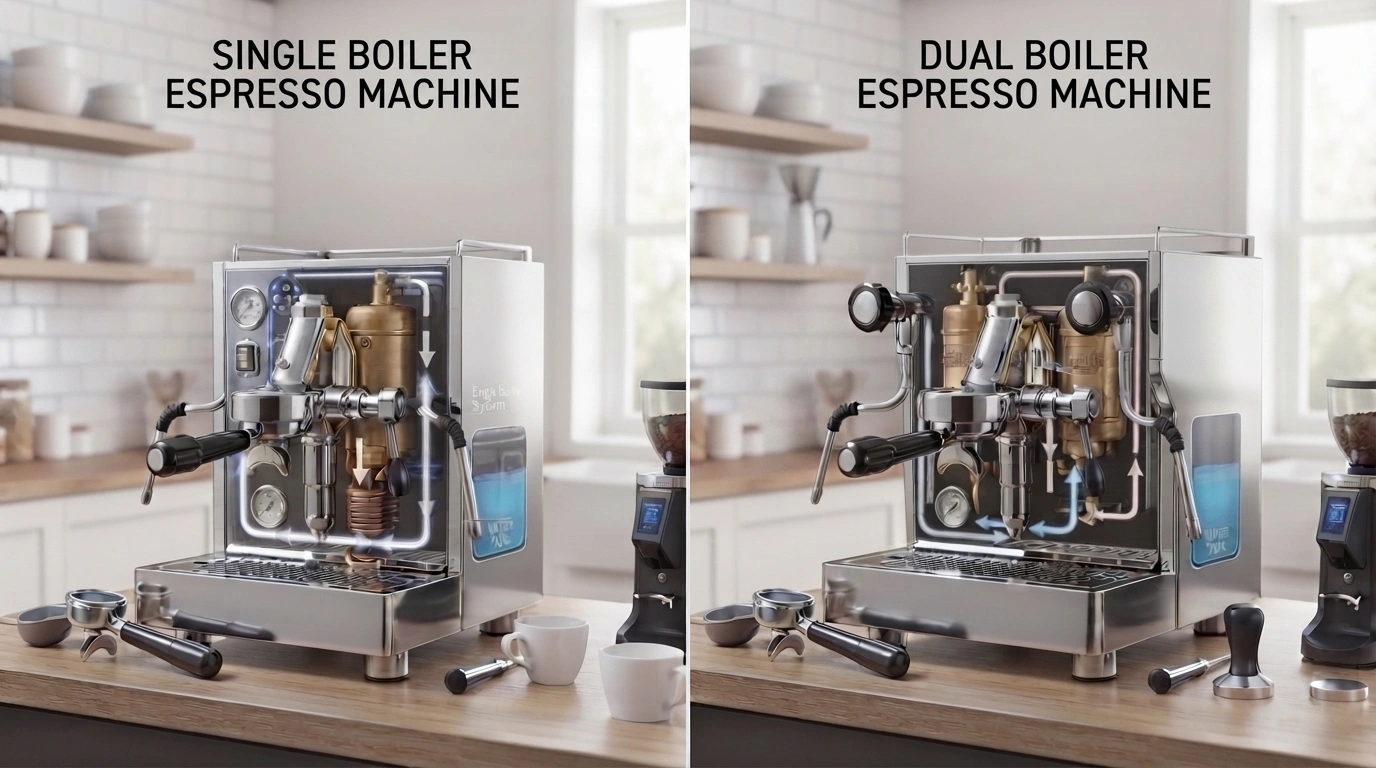
Choosing between a single-boiler and dual-boiler espresso machine can be confusing. Both designs can produce excellent espresso. The main difference is how each machine handles brewing water and steam.
A single-boiler machine uses one boiler for both tasks. A dual-boiler machine uses separate boilers for brewing and steaming. That difference affects workflow, temperature control, steaming performance, drink speed, machine size, price, and overall complexity.
For many home baristas, a single boiler provides everything they need. For people who regularly make several milk drinks or want more control over brewing temperature, a dual boiler can be worth the extra cost.
This guide explains how both systems work, what their strengths and weaknesses are, and which type makes more sense for your home espresso setup.
Single Boiler vs Dual Boiler at a Glance
| Feature | Single Boiler | Dual Boiler |
| Number of boilers | 1 | 2 |
| Brew and steam at the same time | No | Yes |
| Temperature control | Usually simpler | Usually more precise |
| Milk steaming | Good | Excellent |
| Workflow | Slower between brewing and steaming | Faster |
| Machine size | Usually smaller | Usually larger |
| Energy use | Usually lower | Usually higher |
| Price | Usually lower | Usually higher |
| Maintenance | Simpler | More components to maintain |
| Best for | Casual home users | Frequent milk-drink makers and enthusiasts |
| Learning curve | Moderate | Moderate to advanced |
| Overall value | Excellent for many users | Best for specific needs |
The biggest thing to understand is simple:
A dual-boiler machine does not automatically make better espresso.
It mainly gives you more control and a faster workflow.
What Is a Single-Boiler Espresso Machine?
A single-boiler espresso machine has one boiler that handles the machine’s hot-water needs. Depending on the design, that boiler switches between brewing and steaming temperatures. Brewing espresso requires water at a much lower temperature than steaming milk.
The machine therefore cannot normally brew espresso and produce steam at full power at the same time. You brew your espresso first. Then you activate steam mode. The boiler heats to a higher temperature. You steam your milk. After that, the machine needs to return to brewing temperature. This process works well for one or two drinks.
It becomes less convenient when you prepare several milk-based drinks in succession.
How a Single Boiler Works
The basic workflow looks like this:
1. Heat the boiler to brewing temperature.
The machine prepares water for espresso extraction.
2. Brew the espresso.
Water passes through the coffee grounds and into your cup.
3. Switch to steam mode.
The machine raises the boiler temperature.
4. Steam the milk.
You use the steam wand to texture your milk.
5. Return to brewing temperature.
The machine cools or refills the boiler as needed before the next espresso.
This is why single-boiler machines can feel slower when making multiple cappuccinos or lattes.
What Is a Dual-Boiler Espresso Machine?
A dual-boiler machine has two separate boilers. One boiler handles espresso brewing. The second boiler handles steam.
The brewing boiler can stay at an appropriate espresso temperature while the steam boiler remains hot enough to produce steam. That allows you to brew espresso and steam milk at the same time.
This design removes one of the biggest workflow limitations of a single-boiler machine. You do not have to wait for the machine to change between brewing and steaming temperatures.
That makes a dual boiler particularly useful when preparing several milk-based drinks.
Single Boiler vs Dual Boiler: The Main Difference
The easiest way to understand the difference is to imagine making a cappuccino.
With a single boiler, the workflow is generally:
Brew → switch to steam → wait → steam milk → return to brewing
With a dual boiler:
Brew + steam simultaneously
That sounds like a small difference. It is not.
If you make one cappuccino every morning, the difference may barely matter.
If you make four or six milk drinks when friends visit, it becomes much more noticeable.
This is why your drinking habits matter more than the number of boilers alone.
Can a Single-Boiler Espresso Machine Make Good Espresso?
Absolutely. A single boiler does not mean poor espresso quality. Many excellent home espresso machines use single-boiler designs. The quality of your espresso depends on many other factors. These include:
- Grinder quality
- Coffee freshness
- Grind size
- Dose
- Distribution
- Tamping
- Water quality
- Brewing temperature
- Pressure
- Extraction time
- Your technique
The boiler design is only one part of the system. A well-used single-boiler machine with a good grinder can produce better espresso than an expensive dual-boiler machine paired with a poor grinder.
If you are still deciding how much attention to give your grinder, our guide on do you need a grinder for an espresso machine explains why it matters so much.
Internal link: do you need a grinder for an espresso machine → Do You Need a Grinder for an Espresso Machine?
Slug: /do-you-need-a-grinder-for-an-espresso-machine/
What Are the Advantages of a Single Boiler?
Single-boiler machines remain popular for good reasons. They offer a relatively simple way to enter traditional espresso without paying for a more complex heating system.
1. Lower Purchase Price
Single-boiler machines generally cost less than comparable dual-boiler machines. You are paying for fewer heating components and a simpler system. That can make a single boiler especially attractive to beginners. You can also use the money you save for a better grinder.
2. Smaller Footprint
A single boiler usually requires less internal space. That can translate into a smaller machine. This matters if your kitchen counter has limited room.
If countertop space is one of your main concerns, see our guide to best compact espresso machines.
Internal link: best compact espresso machines → Best Compact Espresso Machines
Slug: /best-compact-espresso-machines/
3. Simpler Design
A single-boiler machine has fewer major heating components. That can make the overall system easier to understand. It can also simplify maintenance and troubleshooting.
You still need to clean and descale the machine regularly, but there are fewer boiler-related components compared with a dual-boiler system.
4. Lower Energy Demand
A single-boiler machine does not need to maintain a separate steam boiler at high temperature throughout your brewing session. That can reduce energy use.
The actual difference depends on the machine’s insulation, heating elements, usage pattern, and standby behavior. Still, a simpler heating system generally requires less hardware to keep hot.
5. Excellent for Straight Espresso
If you mostly drink espresso, an additional steam boiler may provide little benefit.
Why pay for a second boiler if you rarely steam milk? This is one of the most important buying decisions to make.
Buy for your habits, not for the specification sheet.
What Are the Disadvantages of a Single Boiler?
The main limitation is workflow.
1. You Cannot Brew and Steam at the Same Time
This is the biggest difference. The boiler needs to operate at different temperatures for brewing and steaming. You therefore need to switch between the two functions. That creates waiting time.
2. Milk Drinks Take Longer
A latte or cappuccino involves espresso and steamed milk. With a single boiler, you normally have to complete the brewing stage before steaming. You may then need to wait for the machine to return to brewing temperature.
For one drink, this is manageable. For several drinks, it becomes frustrating.
3. Temperature Management Can Require More Attention
Traditional single-boiler machines often require more hands-on temperature management. Some machines include better electronic controls or PID systems that make this easier. Others rely on thermostats and user timing.
If you want to understand how electronic temperature control works, read our guide on PID temperature control in an espresso machine.
Internal link: PID temperature control in an espresso machine → What Is PID Temperature Control in an Espresso Machine?
Slug: /what-is-pid-temperature-control-in-an-espresso-machine/
What Are the Advantages of a Dual Boiler?
Dual boilers solve the main workflow limitation of a single boiler.
1. Brew and Steam at the Same Time
This is the biggest advantage. The brew boiler stays at espresso temperature. The steam boiler stays at a higher temperature. You can therefore extract espresso while steaming milk.
That makes the process faster and more convenient.
2. Better Temperature Control
Dual-boiler machines can give you independent control over the brewing and steaming systems. The brewing boiler can focus on espresso temperature. The steam boiler can focus on steam production.
This separation is particularly useful for enthusiasts who want precise control over their brewing process.
3. Stronger Milk-Drink Workflow
If you frequently prepare lattes and cappuccinos, a dual boiler can make a major difference. You can steam milk without interrupting the espresso-brewing process. That makes the machine feel much more capable during busy mornings or when serving guests.
If milk drinks are your priority, our guide to best espresso machines for lattes covers machines selected specifically for that use case.
Internal link: best espresso machines for lattes → Best Espresso Machines for Lattes
Slug: /best-espresso-machines-for-lattes/
4. Better for Multiple Drinks
Imagine preparing four cappuccinos.
A single-boiler machine may require repeated transitions between brewing and steaming.
A dual boiler handles both tasks simultaneously. The time savings become increasingly useful as the number of drinks increases.
What Are the Disadvantages of a Dual Boiler?
Dual boilers are not automatically the best choice. They come with trade-offs.
1. Higher Price
The biggest disadvantage is cost. A second boiler, additional heating hardware, controls, sensors, plumbing, and electronics all add complexity.
That generally pushes the purchase price higher.
2. Larger Machines
Dual-boiler machines often take up more counter space. Some also weigh considerably more. This is not a problem for everyone. But it matters if you have a small kitchen.
3. More Complex Maintenance
More components mean more things to maintain. A dual-boiler machine can have:
- Two boilers
- Two heating systems
- Additional temperature sensors
- More plumbing
- More valves
- More electrical components
This does not mean dual boilers are unreliable. It simply means there are more components in the system.
4. More Machine Than Some Users Need
If you drink one espresso every morning, a dual boiler may be excessive. You might spend hundreds or even thousands more for capabilities you rarely use.
A simpler machine can be the smarter purchase.
Single Boiler vs Dual Boiler: Temperature Stability
Temperature stability is often misunderstood. Some people assume:
Dual boiler = better espresso automatically.
That is not necessarily true. A well-designed single-boiler machine can maintain stable brewing temperatures.
Modern machines may use:
- PID controllers
- Better insulation
- Improved boiler materials
- Thermoblocks
- Improved grouphead designs
A dual boiler’s major advantage is independent temperature management. You can set or maintain the brewing system separately from the steam system. That gives you more control.
But you still need good technique.
Does PID Matter More Than Boiler Type?
This depends on what you want. PID temperature control can help maintain a more consistent brewing temperature.
A single-boiler machine with a good PID system can therefore offer excellent temperature control.
A dual-boiler machine without sophisticated temperature management can still have limitations.
So do not judge a machine only by the number of boilers. Look at the entire heating and temperature-control system.
Single Boiler vs Dual Boiler for Milk Drinks
If you regularly drink cappuccinos, lattes, flat whites, or other milk-based drinks, the difference becomes more important.
A single boiler can produce excellent steam. The problem is the transition between brewing and steaming.
A dual boiler eliminates that transition. This gives the dual boiler a clear workflow advantage.
For occasional milk drinks:
Single boiler is usually enough.
For daily milk drinks:
Either can work, but dual boiler is more convenient.
For several milk drinks at once:
Dual boiler is the better choice.
Single Boiler vs Dual Boiler for Espresso Only
If you mostly drink straight espresso, the calculation changes. You do not need a dedicated steam boiler if you rarely steam milk. A good single boiler can provide everything you need. In this situation, spending more on a dual boiler may offer little practical benefit.
Instead, put the extra money toward:
- A better grinder
- Better water filtration
- Fresh coffee
- A quality scale
- A better tamper
- Proper espresso accessories
The grinder should usually receive serious attention.
Which Is Better for Beginners?
For most beginners, I recommend starting with a single boiler unless you already know that you will make lots of milk drinks. A single boiler is easier to justify financially. It also lets you learn the fundamentals without paying for features you may not need.
However, there is another important consideration. Some beginners want convenience. If you know that you will make several lattes every day, a dual boiler can actually be the better beginner purchase because you will not outgrow the workflow as quickly.
If you want to compare machines specifically for new users, see best espresso machines for beginners.
Internal link: best espresso machines for beginners → Best Espresso Machines for Beginners
Slug: /best-espresso-machines-for-beginners/
Single Boiler vs Dual Boiler for Experienced Baristas
Experienced baristas often appreciate the control offered by a dual-boiler system. Independent brewing and steaming temperatures make the workflow more flexible.
But experienced users can also get excellent results from a single boiler. The choice comes down to priorities.
If you enjoy a slower, hands-on workflow and mostly drink espresso, a single boiler can be very satisfying.
If you want speed, repeatability, and high-volume milk-drink preparation, a dual boiler makes more sense.
Can a Single Boiler Steam Milk Well?
Yes. A single-boiler machine can produce powerful steam. The limitation is not necessarily steam quality. It is steam availability and workflow.
Once the machine switches to steam temperature, it can produce excellent microfoam when paired with a good steam wand and proper technique.
The issue comes before and after steaming. You have to transition between brewing and steaming temperatures. That is what the second boiler eliminates.
Can Dual Boilers Brew and Steam at the Same Time?
Yes. That is the defining advantage of the design. The brew boiler handles espresso extraction. The steam boiler supplies steam. Both can operate simultaneously.
This is particularly helpful when making multiple milk drinks.
What About Heat-Exchanger Espresso Machines?
There is a third design worth knowing about. It is called a heat exchanger, often abbreviated as HX. A heat-exchanger machine uses one steam boiler but routes fresh brewing water through a heat-exchange system. This allows the machine to brew espresso and steam milk simultaneously. So the basic categories are:
- Single boiler
- Heat exchanger
- Dual boiler
Heat exchangers can provide excellent performance. They also have their own temperature-management characteristics. If you are comparing espresso machines more broadly, understanding these three heating designs will help you make a much better decision.
Single Boiler vs Heat Exchanger vs Dual Boiler
| Feature | Single Boiler | Heat Exchanger | Dual Boiler |
| Boilers | 1 | 1 | 2 |
| Brew and steam together | No | Yes | Yes |
| Independent brew boiler | No | No | Yes |
| Steam power | Good | Very good | Excellent |
| Temperature control | Depends on design | Requires technique | Excellent |
| Size | Usually smaller | Medium to large | Usually larger |
| Price | Usually lowest | Mid to high | Usually highest |
| Best for | Espresso-focused users | Milk-drink enthusiasts | Enthusiasts and high-volume users |
The heat exchanger sits between the two designs.
It can deliver simultaneous brewing and steaming without using two boilers. But the brewing temperature behavior differs from a dual boiler.
Single Boiler vs Dual Boiler: Which Uses More Energy?
Generally, a dual-boiler machine requires more energy because it has an additional boiler and heating system. However, actual electricity consumption depends on:
- Boiler size
- Heating-element wattage
- Insulation
- Warm-up time
- Standby duration
- Usage frequency
- Energy-saving features
If you only make one espresso a day, the difference may not matter much. If the machine remains hot for hours, it becomes more relevant.
Which Machine Is Easier to Maintain?
A single boiler generally has the simpler system. That does not mean maintenance disappears. You still need to:
- Clean the grouphead
- Backflush when appropriate
- Clean the steam wand
- Empty the drip tray
- Clean the water reservoir
- Monitor water quality
- Descale when necessary
A dual boiler needs the same basic care. It simply has more components within the heating system.
Our guide on how to clean an espresso machine covers the regular cleaning tasks every home barista should understand.
Internal link: how to clean an espresso machine → How to Clean an Espresso Machine
Slug: /how-to-clean-an-espresso-machine/
Does Boiler Material Matter?
Yes, but it should not be considered in isolation. Espresso machines can use different materials for their boilers, including:
- Stainless steel
- Brass
- Aluminum
- Copper
Each material has different characteristics related to heat transfer, durability, corrosion resistance, and manufacturing cost. But boiler material alone does not determine espresso quality. The complete thermal system matters more.
Does Boiler Size Matter?
Yes. A larger boiler generally provides more thermal mass and can support longer steaming. But bigger is not always better.
A larger steam boiler can be useful for making multiple milk drinks.
A larger brew boiler can provide greater thermal capacity.
However, larger boilers also increase machine size, warm-up requirements, and potentially energy consumption. The ideal size depends on how you use the machine.
Single Boiler vs Dual Boiler: What About Water Temperature?
Espresso brewing requires controlled water temperature. Steam requires much higher temperatures.
A single boiler must move between these temperature ranges.
A dual boiler can maintain both temperatures separately.
That is the fundamental thermal advantage of the dual-boiler design. The difference becomes especially useful during back-to-back milk drinks.
Which Is Better for a Small Kitchen?
A single boiler usually wins. Its simpler heating system allows manufacturers to keep the machine smaller. If your counter space is limited, look at the machine’s:
- Width
- Depth
- Height
- Water-tank location
- Portafilter clearance
- Steam-wand movement
- Space above the machine
Do not look at width alone. A machine can have a narrow footprint but still require substantial space above it.
Which Is Better for a Family?
This depends on how many people drink espresso. For one or two people who mostly drink straight espresso, a single boiler can be sufficient.
For a family where several people want lattes or cappuccinos at breakfast, a dual boiler becomes much more attractive.
The ability to brew and steam simultaneously reduces waiting. That matters when everyone wants their drink at the same time.
Which Is Better for Entertaining Guests?
Dual boiler. This is one situation where the advantage is obvious.
If you regularly prepare six or eight milk drinks for guests, the workflow difference becomes significant. You can brew and steam without repeatedly waiting for the boiler to switch modes.
A single boiler can still handle the job. It just takes more time and attention.
Single Boiler vs Dual Boiler: Which Should You Buy?
Use this simple decision guide.
Buy a single boiler if:
- You mostly drink espresso.
- You make only one or two milk drinks at a time.
- You have a limited budget.
- You want a smaller machine.
- You prefer a simpler system.
- You are comfortable waiting between brewing and steaming.
- You want to spend more on a grinder.
Buy a dual boiler if:
- You drink lots of lattes and cappuccinos.
- You make several drinks at once.
- You entertain frequently.
- You want simultaneous brewing and steaming.
- You want independent brew and steam temperatures.
- You prioritize workflow speed.
- You are comfortable paying more.
What Should You Spend Your Budget On?
This is where many first-time buyers make a mistake. They see a dual-boiler machine and assume it is automatically the better investment. But your espresso setup has several important components. A balanced setup might include:
Espresso machine + grinder + coffee + water + accessories
If upgrading from a $500 single boiler to a $1,500 dual boiler leaves you with a poor grinder, the extra boiler may not improve your espresso as much as expected.
A good grinder can make a huge difference. So consider the entire system rather than the machine alone.
Quick Decision Table
| Your situation | Recommended choice |
| Mostly straight espresso | Single boiler |
| One latte each morning | Single boiler |
| Several lattes every day | Dual boiler |
| Large family | Dual boiler |
| Frequent entertaining | Dual boiler |
| Limited counter space | Single boiler |
| Tight budget | Single boiler |
| Maximum workflow speed | Dual boiler |
| Maximum temperature independence | Dual boiler |
| Beginner on a budget | Single boiler |
| Espresso enthusiast | Either |
| Heavy milk-drink use | Dual boiler |
Final Thoughts
The choice between a single-boiler and dual-boiler espresso machine ultimately comes down to how you drink espresso. A single boiler is often the smarter choice for people who mostly drink straight espresso, make only occasional milk drinks, have limited counter space, or want to keep more money available for a quality grinder. A dual boiler makes more sense when you regularly prepare lattes and cappuccinos, make several drinks at once, entertain guests, or want independent control over brewing and steaming temperatures. Neither design guarantees better espresso on its own.
A well-balanced setup, good grinder, fresh coffee, proper technique, and consistent maintenance still matter enormously. For many home baristas, a single boiler is enough. For serious milk-drink enthusiasts, the workflow advantage of a dual boiler can justify the higher cost.