How to Choose an Espresso Machine
Choosing an espresso machine can feel harder than making espresso.
Online stores offer hundreds of models with different prices, heating systems, controls, grinders, and features. You may also see technical terms such as PID, dual boiler, heat exchanger, thermoblock, pre-infusion, and pump pressure.
You do not need to understand every specification before buying an espresso machine. The better approach is to start with your coffee habits, budget, kitchen space, and preferred workflow. Once you know what you need, many machines become much easier to eliminate.
This guide will help you understand what matters before comparing individual espresso machines.
Start With Your Coffee Routine
The best espresso machine for you depends heavily on what you drink and how you make it.
Think about your normal morning before looking at machine specifications. Do you drink straight espresso? Do you make lattes every day? Do you prepare several drinks for your family? Or do you simply want good coffee without spending much time learning the process?
These questions matter because different machines suit different routines.
If you mostly drink straight espresso, focus more on brewing control, temperature stability, grinder quality, and shot consistency. You may not need a powerful steam system.
If you make several lattes or cappuccinos every morning, steaming becomes much more important. You will want a machine that can handle milk preparation without slowing down your routine. If several people use the machine, consider water capacity, heating speed, recovery time, and cleaning.
Before comparing individual models, it helps to understand the main espresso machine types and what each type does differently.
Internal link destination: Espresso Machine Types Explained
Slug: /espresso-machine-types/
Decide How Much Control You Want
Espresso can be as hands-on or as automated as you want.
Some people enjoy weighing coffee, adjusting the grind, tamping the grounds, and watching the shot develop. Others want to press a button and get their drink quickly.
Neither approach is wrong. The important thing is choosing a machine that matches your preferred workflow.
Manual Espresso Machines
Manual machines give you the greatest control over the brewing process. You handle most of the work yourself. That can make the experience rewarding, especially if you enjoy learning how espresso works.
The trade-off is a steeper learning curve.
Manual machines suit enthusiasts who enjoy experimenting and want maximum involvement.
Semi-Automatic Espresso Machines
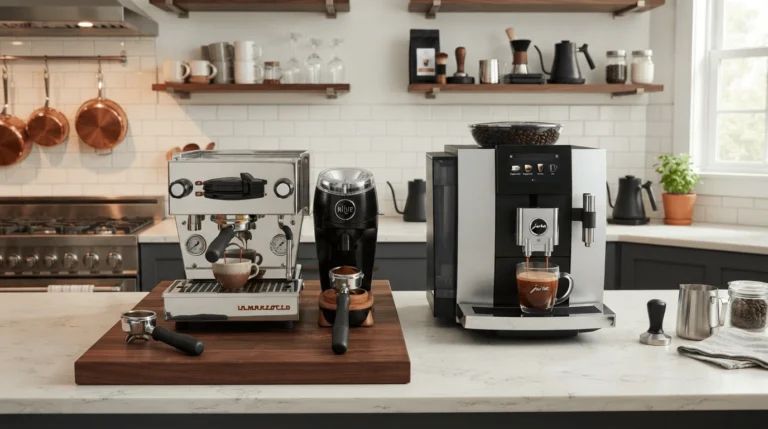
Semi-automatic machines offer a balance between control and convenience. You still handle important steps such as grinding, dosing, tamping, and managing the shot. The machine handles the pump and water delivery.
This makes semi-automatic machines popular with home users who want to learn espresso without doing everything manually.
Automatic Espresso Machines
Automatic machines reduce the amount of work required from you.
Depending on the machine, you may be able to program the amount of water used for a shot. This creates a simpler and more repeatable workflow.
They suit people who want traditional espresso preparation with less manual involvement.
Super-Automatic Espresso Machines
Super-automatic machines automate much of the process. Many models can grind beans, dose coffee, brew espresso, and prepare milk drinks with minimal input.
They are convenient and easy to use.
The trade-off is reduced control over the brewing process.
Which Type Fits Your Routine?
| Machine type | Control | Convenience | Learning curve | Best suited to |
| Manual | Very high | Low | High | Espresso enthusiasts |
| Semi-automatic | High | Medium | Medium | Hands-on home users |
| Automatic | Medium | High | Low | Convenience-focused users |
| Super-automatic | Low | Very high | Very low | One-touch coffee |
If you want to learn espresso, a semi-automatic machine can offer a useful middle ground.
If you want speed and convenience, more automation may make sense.
For a deeper comparison, see our guide to semi-automatic vs super-automatic espresso machines.
Internal link destination: Semi-Automatic vs Super-Automatic Espresso Machines
Slug: /semi-automatic-vs-super-automatic-espresso-machines/
Set a Realistic Budget
Your espresso budget should cover more than the machine. A complete setup may include the machine, grinder, tamper, scale, milk pitcher, cleaning supplies, and coffee beans.
That means a $500 machine does not necessarily mean a $500 espresso setup. Instead of asking, “How much should I spend on the machine?” ask:
How much can I spend on the complete setup?
A lower budget may require more compromises. You may get simpler controls, fewer convenience features, or a smaller heating system.
A mid-range budget can provide a useful balance between control, convenience, construction, and performance.
Higher-priced machines can offer stronger steaming, more advanced temperature management, faster workflows, and additional controls.
But a higher price does not automatically mean better espresso. You should pay for features that solve problems you actually have.
Do Not Overlook the Grinder
The espresso machine gets most of the attention, but the grinder plays a major role in your setup. Espresso requires a fine and consistent grind. Small changes in grind size can change how quickly water passes through the coffee. That affects extraction.
A good espresso machine cannot completely compensate for an unsuitable grinder. If you are starting from scratch, think about your machine and grinder as one system.
A machine with excellent brewing hardware can still produce disappointing results when the grinder cannot provide suitable grounds.
If you are unsure whether you need one, our guide explains what to look for in an espresso grinder and when a separate grinder makes sense.
Internal link destination: Do You Need a Grinder for an Espresso Machine?
Slug: /do-you-need-a-grinder-for-an-espresso-machine/
Choose Between a Built-In and Separate Grinder
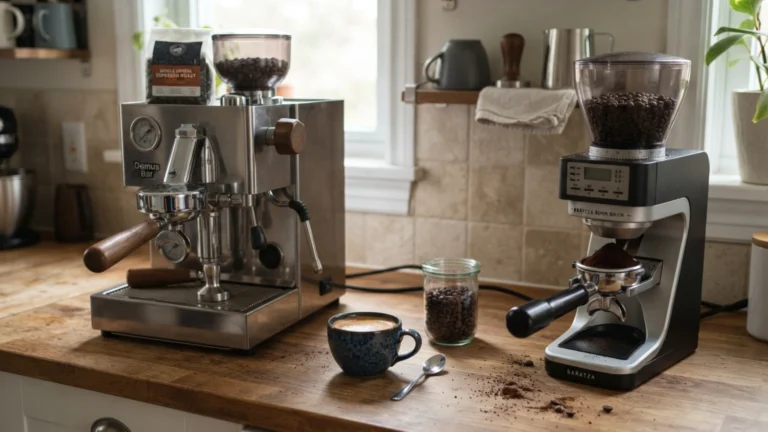
Some espresso machines include a grinder. Others require you to buy one separately.
A built-in grinder can make your setup simpler. You have fewer appliances, fewer cables, and less equipment on the counter. That can be especially useful in a small kitchen.
The downside is flexibility. If the built-in grinder becomes the weakest part of your setup, upgrading it may mean replacing the entire machine.
A separate grinder gives you more freedom.
You can upgrade the grinder later without replacing your espresso machine. You can also choose a grinder based on your preferred beans, brewing style, and budget.
Built-In Grinder
Best for:
- Simple setups
- Limited counter space
- Beginners
- Fewer separate appliances
Separate Grinder
Best for:
- Greater flexibility
- Easier upgrades
- Espresso enthusiasts
- More control over grinding
A simple rule works well here:
Choose a built-in grinder for simplicity. Choose a separate grinder for flexibility.
Measure Your Counter Space
A machine can look compact in product photos and still take up more room than expected. Measure your counter before buying.
Check the machine’s:
- Width
- Depth
- Height
- Water-tank access
- Portafilter clearance
- Steam-wand movement
Also think about your grinder. You need enough space to use both appliances comfortably. Cabinet clearance matters too. A machine may fit under your cabinets but still make the water tank difficult to remove.
If counter space is limited, look at our recommendations for best compact espresso machines.
Internal link destination: Best Compact Espresso Machines
Slug: /best-compact-espresso-machines/
Consider How Many Drinks You Make
Your daily drink volume can change which machine makes sense. If you make one or two drinks each morning, you may not need a large machine with a powerful heating system. A smaller machine can be easier to fit, use, and maintain.
But your needs change when you make several drinks in a row. You may want:
- Faster heating
- More water capacity
- Better steam recovery
- Stronger steam performance
- Easier cleaning
If you regularly make drinks for several people, the heating system becomes especially important.
Understand the Heating System
The heating system determines how a machine handles brewing and steaming. You will commonly encounter four designs:
- Thermoblock or thermocoil
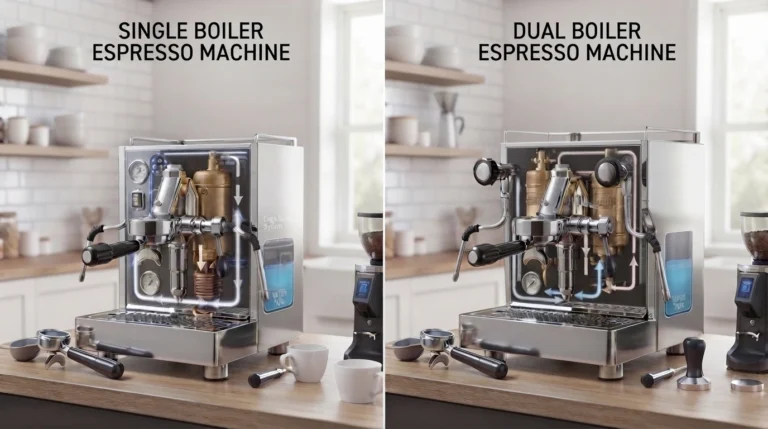
- Single boiler
- Heat exchanger
- Dual boiler
Each has advantages and trade-offs.
Single Boiler
A single-boiler machine uses one boiler for brewing and steaming. Because brewing and steaming require different temperatures, you generally switch between the two functions.
This can work well if you mostly drink straight espresso or make milk drinks occasionally.
Single boilers can also make sense when space and budget matter. The main limitation is the wait between brewing and steaming.
Heat Exchanger
A heat-exchanger machine uses one boiler with a separate path for brewing water. This design can allow you to brew and steam at the same time.
That makes it attractive for people who regularly prepare milk-based drinks.
Dual Boiler
A dual-boiler machine has separate boilers for brewing and steaming. Each boiler can operate at a temperature suited to its job. This makes back-to-back brewing and steaming easier.
The trade-offs are usually higher cost, greater size, and increased complexity.
Thermoblock and Thermocoil Systems
These systems heat water as it moves through the machine. They can support compact designs and quick heat-up times.
You will often find these systems in smaller home machines.
Which Heating System Should You Choose?
| Your routine | Systems worth considering |
| Mostly straight espresso | Single boiler or thermoblock |
| Occasional milk drinks | Single boiler or thermoblock |
| Frequent milk drinks | Heat exchanger or dual boiler |
| Several milk drinks in a row | Dual boiler or capable heat exchanger |
| Small kitchen | Compact thermoblock-based machine |
These are general guidelines. Individual machines can perform differently even when they use the same basic heating technology.
Look for Useful Temperature Control
Temperature affects espresso extraction. That makes temperature stability an important consideration when comparing machines.
You may see the term PID in espresso machine specifications. PID stands for proportional-integral-derivative control. In simple terms, it helps manage temperature more precisely. Consistent temperature can help create more repeatable brewing conditions.
But PID should not become the deciding factor by itself.
A beginner may gain more from a good grinder, simple controls, and an easy workflow than from a long list of advanced features. If you want to understand the other features that matter, our guide to PID temperature control and other espresso machine features goes deeper.
Internal link destination: Espresso Machine Features Explained
Slug: /espresso-machine-features/
Do Not Choose a Machine Based on Bar Pressure Alone
You will often see espresso machines advertised with pump ratings such as 15 or 20 bars. It is tempting to assume that more pressure means better espresso. That is not a reliable way to compare machines. The maximum pump rating does not tell you everything about the pressure used during extraction.
The complete brewing system matters. Look at pressure regulation, water delivery, temperature management, and the machine’s overall design.
Do not let a large number on the box make the buying decision for you.
Understand Pre-Infusion
Pre-infusion wets the coffee before full brewing pressure develops. This can help prepare the coffee bed for extraction. Some machines provide automatic pre-infusion. Others offer more control over how it works. It is a useful feature to understand, especially if you want to learn espresso.
Still, it should not dominate your buying decision.
Your grinder, coffee, dose, grind size, and preparation technique also affect the final shot.
Pay Attention to the Steam Wand
If you mainly drink espresso straight, the steam wand may not matter much. If you love lattes and cappuccinos, it becomes much more important.
Look at:
- Steam power
- Wand movement
- Control
- Ease of cleaning
- Milk-texturing ability
A manual steam wand gives you greater control. It also requires practice. You need to learn how to position the wand and create the texture you want. Automatic milk systems make the process easier. They can be useful when convenience matters more than hands-on control.
If milk drinks are a major part of your routine, our guide to the best espresso machines for lattes focuses specifically on this type of use.
Internal link destination: Best Espresso Machines for Lattes and Milk Drinks
Slug: /best-espresso-machines-for-lattes/
Understand the Portafilter and Basket
The portafilter holds the coffee basket during brewing. The basket holds the ground coffee.
You may encounter pressurized and non-pressurized baskets.
Pressurized Baskets
Pressurized baskets make the brewing process more forgiving. They can help beginners who are still learning about grind size and coffee preparation.
Non-Pressurized Baskets
Non-pressurized baskets give you greater control over extraction. They also demand more from your grinder and technique.
You need to pay closer attention to:
- Grind size
- Dose
- Distribution
- Tamping
- Extraction time
If you want to improve your espresso skills, non-pressurized baskets give you more room to learn.
Think About the Learning Curve
Before choosing a machine, ask yourself:
Do I want to learn how to make espresso, or do I simply want espresso at home?
Those are different goals.
A semi-automatic machine can teach you how grinding, dosing, tamping, extraction, and milk steaming affect your drink. That process can be rewarding. It can also be frustrating at first.
A super-automatic machine removes much of that work. You give up some control, but you gain convenience.
Choose More Control If You:
- Enjoy learning
- Like experimenting
- Want to adjust your shots
- Enjoy hands-on preparation
Choose More Automation If You:
- Want coffee quickly
- Prefer simple routines
- Have several people using the machine
- Value convenience over experimentation
The best machine is the one you will actually enjoy using.
Think About Maintenance Before Buying
Every espresso machine needs maintenance. The exact routine varies by machine, but common tasks include cleaning the brewing area, rinsing the portafilter, cleaning the steam wand, emptying the drip tray, and following the manufacturer’s descaling instructions.
Machines with grinders or automatic milk systems can require additional cleaning. Milk residue deserves special attention. If you use a steam wand, clean it after every use.
Before buying, check how the machine handles routine cleaning and which parts require regular attention.
A machine that looks perfect on paper may become frustrating if its maintenance routine does not fit your habits.
Do Not Pay for Features You Will Never Use
A longer feature list does not automatically make an espresso machine better. Before paying more for a feature, ask:
Will this improve my daily coffee routine?
A touchscreen may look impressive. But if you make the same drink every morning, you may not need one. A large drink menu may sound useful. But you may only drink espresso and lattes. Advanced controls can also increase the learning curve.
Spend your money on features that solve a problem you actually have.
Match the Machine to Your Routine
At this point, your choice should become clearer.
| If you want… | Consider… |
| Maximum hands-on control | Manual or semi-automatic |
| Control with an easier workflow | Semi-automatic |
| Easier espresso preparation | Automatic |
| One-touch coffee | Super-automatic |
| Mostly straight espresso | Brewing-focused machine |
| Many milk drinks | Strong steam system |
| Several drinks back-to-back | Heat exchanger or dual boiler |
| Limited counter space | Compact machine |
| One integrated appliance | Built-in grinder |
| Easier future upgrades | Separate grinder |
Think of this table as a starting point, not a strict rule.
Individual machines can perform differently even when they use the same basic technology.
Common Espresso Machine Buying Mistakes
Spending the Entire Budget on the Machine
Remember the grinder and accessories. A complete espresso setup costs more than the machine alone.
Choosing Based on Pressure Numbers
A 20-bar label does not guarantee better espresso. Look at the complete brewing system.
Ignoring Counter Space
Measure before you buy. Remember the space required to operate, refill, clean, and store accessories.
Buying Features You Do Not Need
Do not pay extra for features that will not improve your routine.
Ignoring Maintenance
Cleaning is part of owning an espresso machine.
Buying Too Much Machine
You may not need a large dual-boiler machine if you make two straight espressos every morning.
Buying Too Little Machine
A small machine may become frustrating if you regularly prepare several milk drinks.
Choosing the Machine Before Your Workflow
This is one of the easiest mistakes to make.
Start with your routine. Then choose the machine.
Use This Simple Decision Guide
Still unsure?
Answer these questions.
Do you want hands-on control?
Yes: Consider a manual or semi-automatic machine.
No: Consider an automatic or super-automatic machine.
Do you drink mostly milk-based drinks?
Yes: Prioritize steam performance and heating capacity.
No: Focus more on brewing performance and temperature control.
Do you make several drinks back-to-back?
Yes: Consider a stronger heating system.
No: A simpler machine may be enough.
Do you have limited counter space?
Yes: Measure carefully and prioritize compact designs.
No: You have more flexibility.
Do you already own an espresso grinder?
Yes: Consider a machine without a built-in grinder.
No: Compare an integrated machine with a separate grinder.
Do you enjoy learning espresso?
Yes: A semi-automatic machine may suit you.
No: Consider more automation.
Espresso Machine Buying Checklist
Before you buy, make sure you can answer these questions:
- What drinks do I make most often?
- How much control do I want?
- What is my total setup budget?
- Do I need a separate grinder?
- How much counter space do I have?
- How many drinks do I make each day?
- Do I need strong milk-steaming performance?
- Which heating system fits my routine?
- Do I need advanced temperature control?
- How much maintenance can I handle?
- Which features will I actually use?
- What warranty and support does the manufacturer provide?
If you can answer these questions, you have already eliminated many unsuitable machines.
Final Thoughts
Choosing an espresso machine becomes much easier when you stop comparing machines by specifications alone. Start with the drinks you make, the amount of control you want, your total budget, your available counter space, and how many people will use the machine. Then consider the grinder, heating system, steam performance, temperature control, maintenance, and features.
The best espresso machine is not necessarily the most expensive model or the one with the longest feature list. It is the machine that fits your coffee habits and makes your daily routine better.
When you are ready to compare specific machines, our Best Espresso Machines guide will help you narrow your choices by budget, experience, and workflow.
Internal link destination: Best Espresso Machines
Slug: /best-espresso-machines/