Gaggia Classic Pro E24 vs Rancilio Silvia: Which Espresso Machine Is Better?
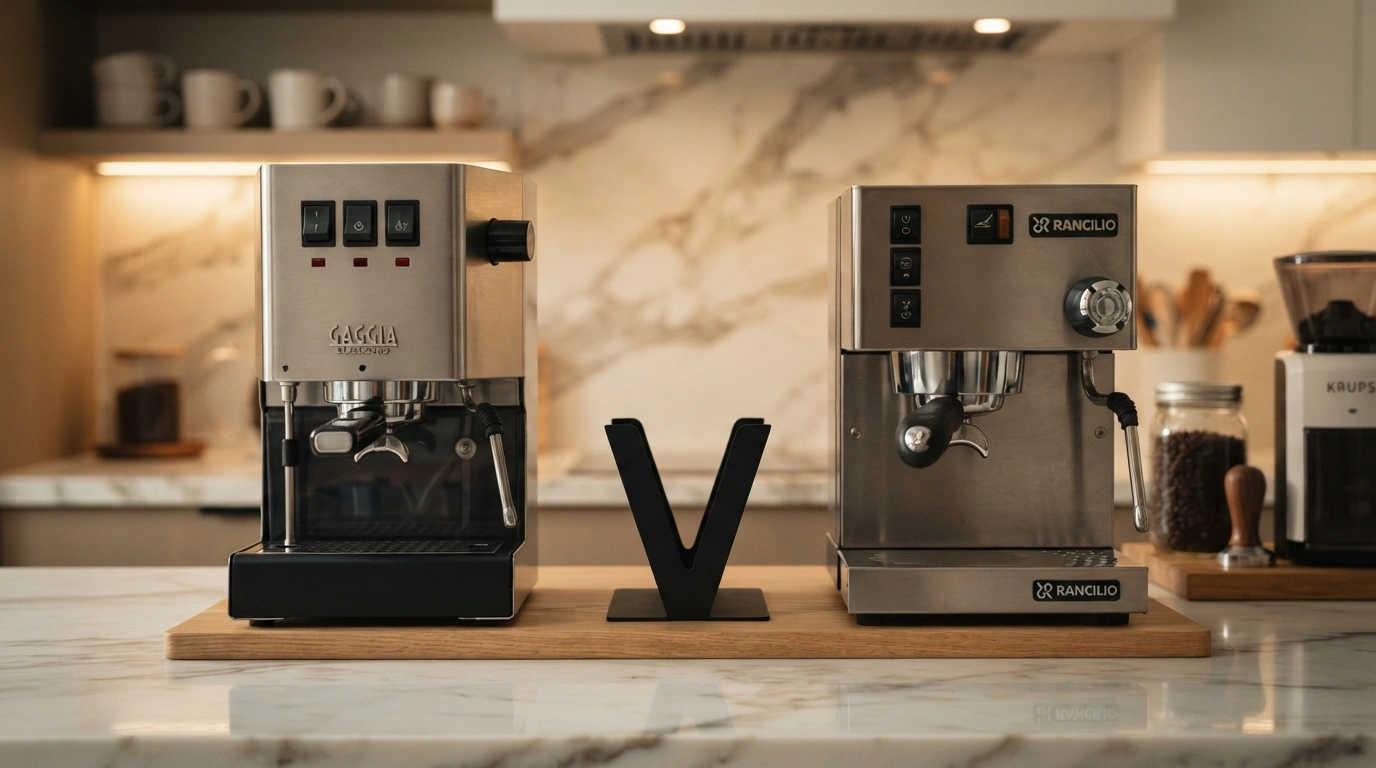
The Gaggia Classic Pro E24 and Rancilio Silvia are two classic choices for home baristas who want a more hands-on espresso experience.
Neither machine includes a built-in grinder. Both use a commercial-style 58mm portafilter, single-boiler designs, manual controls, and traditional steam wands. But they take different approaches.
The Gaggia Classic Pro E24 focuses on value, a compact footprint, and upgraded brass components. The Rancilio Silvia puts more emphasis on heavier construction, a larger physical design, and strong manual steaming performance.
So which one should you buy?
For most budget-conscious home baristas, the Gaggia Classic Pro E24 offers the better overall value. The Rancilio Silvia becomes more attractive if you prioritize heavier construction, steam performance, and a more substantial prosumer-style machine.
Gaggia Classic Pro E24 vs Rancilio Silvia at a Glance
| Feature | Gaggia Classic Pro E24 | Rancilio Silvia |
| Machine type | Semi-automatic | Semi-automatic |
| Built-in grinder | No | No |
| Boiler type | Single brass boiler | Single boiler |
| Boiler capacity | About 0.3L | 0.3L |
| Portafilter | 58mm | 58mm |
| Brew group | Lead-free brass | Brass |
| Steam wand | Professional stainless steel | Stainless steel |
| Pressure gauge | No | No |
| PID | No | No |
| Solenoid valve | Yes | Yes |
| Water tank | 2.1L | 2L |
| Manual milk steaming | Yes | Yes |
| Body | Stainless steel | Stainless steel |
| Dimensions | 9.1 × 10.6 × 14.0 in | 9.3 × 11.4 × 13.4 in |
| Weight | 17.9 lb | 30.8 lb |
| Best for | Value and compact home setups | Heavy-duty manual brewing |
| Typical U.S. price | Around 500–550 | Around $995 |
| Overall value | Excellent | Premium |
The Biggest Difference Between the Gaggia Classic Pro E24 and Rancilio Silvia
The biggest difference is not the portafilter or basic machine type. It is how much machine you get for your money.
The Gaggia Classic Pro E24 is positioned as an accessible entry point into traditional espresso. Its upgraded brass boiler, brass group, 58mm portafilter, solenoid valve, and professional steam wand give it several components associated with more serious espresso equipment.
The Silvia takes that traditional approach further with a heavier 14kg body, brass brewing group, 0.3-liter boiler, commercial-style portafilter, and stainless steel steam wand.
The difference becomes especially important when you look at price. As Gaggia price is in the range of $600, while Rancilio Silvia is in the range of is $1000.
That is a substantial gap. So the real question is:
Does the Silvia give you enough extra performance and build quality to justify spending hundreds more?
For many home users, it does not.
Gaggia Classic Pro E24: What It Does Best
The Gaggia Classic Pro E24 is built around a simple idea. Give home users traditional espresso hardware without pushing them into a high-end price bracket.
The E24 uses a lead-free brass group and brass boiler. Gaggia says the new boiler has higher capacity and stores more heat, helping improve temperature stability and steam performance.
It also uses a professional 58mm stainless steel filter holder. That is important because 58mm is the standard size used across much of the commercial espresso world.
The machine also includes a three-way solenoid valve. After brewing, this valve helps control pressure in the filter holder and makes removing the portafilter cleaner and easier. The E24 therefore gives you a surprisingly traditional espresso setup for its price.
Rancilio Silvia: What It Does Best
The Rancilio Silvia takes a heavier-duty approach. Rancilio describes it as a home machine built around its commercial brewing technology.
The machine weighs 14kg, compared with about 8.1kg for the Gaggia E24. That difference is substantial. The Silvia also uses a brass brewing group and a chrome-plated brass portafilter designed to accommodate filters up to 21g. Its stainless steel steam wand is another major attraction.
The Silvia has earned a reputation among home baristas for its strong manual steaming capability. It does not automate the process. You control the wand position, milk temperature, and texture yourself. That makes it more demanding, but it also gives you a lot of control.
Espresso Quality: Which Makes Better Espresso?
Neither machine automatically wins this category. Both are capable of producing excellent espresso. The quality you get depends heavily on your grinder, coffee beans, dose, grind size, puck preparation, water, and brewing technique.
The Gaggia E24 gives you a brass boiler and brass group with a 58mm portafilter.
The Silvia combines a 0.3-liter boiler with a brass brewing group and commercial-style portafilter.
Neither machine has factory PID temperature control. That means you should not expect either one to behave like a modern dual-boiler machine with electronic temperature management.
Instead, both reward users who learn the fundamentals of espresso preparation. This is where the grinder becomes extremely important.
If you are still deciding whether buying a separate grinder is necessary, see our guide on do you need a grinder for an espresso machine.
Internal link: do you need a grinder for an espresso machine → Do You Need a Grinder for an Espresso Machine?
Slug: /do-you-need-a-grinder-for-an-espresso-machine/
Winner for espresso potential: Tie
Winner for value: Gaggia Classic Pro E24
Boiler and Temperature Stability
Both machines use single-boiler systems.
The Gaggia E24 uses a new lead-free brass boiler. It specifically highlights the boiler’s increased capacity and heat retention as an improvement over the previous design.
The Silvia uses a 0.3-liter coffee boiler. It also uses an insulated boiler and brass brewing group as part of its traditional brewing system.
Neither machine has factory PID control. That matters. A PID controller continuously monitors and adjusts temperature rather than relying solely on a mechanical thermostat.
If you want to understand this technology before choosing a machine, our guide to PID temperature control in an espresso machine explains why it matters.
Internal link: PID temperature control in an espresso machine → What Is PID Temperature Control in an Espresso Machine?
Slug: /what-is-pid-temperature-control-in-an-espresso-machine/
Winner: Gaggia Classic Pro E24 for its newer brass boiler design
But the difference is not large enough to make temperature management effortless.
Does the Gaggia E24 Have PID?
No. This is an important point because some online comparisons confuse different Gaggia Classic generations.
The current Gaggia E24 specification does not list PID temperature control. It instead uses the upgraded brass boiler and traditional thermostat-based temperature regulation.
The Rancilio Silvia also does not have factory PID temperature control in its standard configuration. Rancilio lists manual temperature regulation and a brew-temperature-control thermostat.
So neither machine has a built-in PID advantage.
Portafilter: Both Use 58mm
This is one of the easiest categories to call. Both machines use a 58mm portafilter.
The Gaggia E24 includes a professional 58mm stainless steel filter holder.
The Silvia uses an ergonomic chrome-plated brass portafilter designed around its commercial-style brewing group.
That gives both machines access to a huge range of 58mm accessories. You can find baskets, tampers, distribution tools, and bottomless portafilters in this common size.
If you want to understand why portafilter size matters, see our guide on what a 58mm portafilter is and why it matters.
Internal link: what a 58mm portafilter is and why it matters → What Is a 58mm Portafilter and Why Does It Matter?
Slug: /what-is-a-58mm-portafilter-and-why-does-it-matter/
Winner: Tie
Milk Steaming: Gaggia Classic Pro E24 vs Rancilio Silvia
This is where the Silvia starts to justify its higher price.
Both machines use manual steam wands. Neither relies on automatic milk texturing.
The Gaggia E24 uses a professional stainless steel steam wand. Gaggia specifically positions it for creating milk foam for cappuccinos and other milk drinks.
The Silvia also uses a stainless steel steam wand and a dedicated steam control knob. It has traditionally been regarded as a strong performer for manual steaming. Its heavier construction and steam-focused design make it appealing to users who regularly prepare cappuccinos and lattes.
The Gaggia can still produce excellent microfoam. It simply does not provide the same sense of heavy-duty steam performance that makes the Silvia attractive to enthusiasts.
Winner for milk steaming: Rancilio Silvia
Which Is Better for Lattes and Cappuccinos?
Both machines can make excellent milk drinks. But both require practice. You have to purge the wand. You need to introduce air at the right stage. Then you need to create a smooth vortex and stop steaming at the right temperature.
The Silvia is particularly appealing if milk drinks are a major part of your routine because of its strong manual steaming reputation.
The Gaggia E24 remains capable and costs considerably less.
If milk drinks are your main priority, our guide to best espresso machines for lattes can help you compare more options.
Internal link: best espresso machines for lattes → Best Espresso Machines for Lattes
Slug: /best-espresso-machines-for-lattes/
Winner: Rancilio Silvia
Heating From Brewing to Steaming
Both machines use a single boiler. That means you cannot brew espresso and steam milk at the same time. You brew first. Then you switch to steam mode. The machine heats the boiler to a higher temperature. Then you steam the milk.
Afterward, you need to bring the system back toward brewing temperature. This workflow takes practice. It also means neither machine is ideal for preparing a large number of milk drinks quickly.
The Gaggia E24 has an advantage in practical workflow because its upgraded brass boiler is designed to improve steam stability and duration. Gaggia specifically says the larger brass boiler stores more heat and provides steam for longer.
Winner: Gaggia Classic Pro E24 for value
Winner for heavy manual steaming: Rancilio Silvia
Size and Counter Space
The Gaggia is the more compact machine.
Gaggia lists the E24 at approximately 20 × 35.5 × 27 cm in one current product specification.
The Rancilio Silvia measures 23.5 × 29 × 34 cm, or approximately 9.3 × 11.4 × 13.4 inches.
The dimensions are close enough that neither machine is huge. But the Gaggia is lighter and has a slightly different footprint. The Silvia’s extra depth and substantial weight can matter when you have limited counter space.
Remember to consider space above and around the machine too. You need room to operate the steam wand and refill the water reservoir.
If countertop space is important, our guide to best compact espresso machines covers more compact options.
Internal link: best compact espresso machines → Best Compact Espresso Machines
Slug: /best-compact-espresso-machines/
Winner: Gaggia Classic Pro E24
Build Quality: Which Feels More Substantial?
This is one area where the Silvia has a clear advantage.
The Gaggia E24 weighs about 8.1kg, while the Silvia weighs 14kg.
That is a difference of almost 6kg. The Silvia’s heavier construction gives it a more substantial feel. Its brass brewing group and commercial-style components are designed for durability.
The Gaggia E24 is not poorly built. In fact, its upgraded brass group and boiler are significant improvements. But the Silvia feels more like a commercial machine adapted for home use.
Winner: Rancilio Silvia
Water Tank Capacity
The difference here is small.
The Gaggia E24 has a 2.1-liter water tank.
The Silvia has an integrated 2-liter water tank.
In normal home use, you are unlikely to notice a major difference. Both provide enough capacity for several espresso drinks before refilling.
Winner: Gaggia Classic Pro E24
Controls and Ease of Use
The Gaggia uses a simple control layout with three rocker buttons and indicator lights.
The Silvia also uses traditional controls.
Neither machine has a display. Neither has automatic milk texturing. Neither includes a built-in grinder. That makes both relatively simple machines mechanically. But simplicity does not mean beginner-friendly espresso.
You still need to learn how to grind, dose, tamp, extract, and steam. The Gaggia can be slightly easier to recommend to beginners because of its lower purchase price. The Silvia asks for a much larger financial commitment.
Winner for value and simplicity: Gaggia Classic Pro E24
Which Machine Is Better for Beginners?
The Gaggia Classic Pro E24 is the better choice for most beginners.
There are several reasons. First, it costs considerably less. Second, it provides a commercial-style 58mm portafilter. Third, its upgraded brass boiler and group give beginners room to grow. Fourth, its simple controls make the machine easy to understand. But there is a warning.
Neither machine is a beginner appliance in the same sense as an automatic espresso machine.
You still need a proper grinder. You also need to learn espresso technique.
If you want more beginner-friendly alternatives, see our guide to best espresso machines for beginners.
Internal link: best espresso machines for beginners → Best Espresso Machines for Beginners
Slug: /best-espresso-machines-for-beginners/
Winner for beginners: Gaggia Classic Pro E24
Which Is Better for Experienced Home Baristas?
This is much closer. Experienced baristas may appreciate the Silvia’s heavier construction and powerful manual steam performance. The machine is also a strong platform for people who enjoy controlling the entire brewing process.
But the Gaggia E24 has an important advantage. It gives you much of the traditional espresso experience at a lower cost. That leaves money available for a better grinder. And the grinder is one of the most important components in the entire setup.
So an experienced user with a $500 Gaggia and a strong grinder may have a better overall setup than someone who spends nearly $1,000 on the Silvia but pairs it with a mediocre grinder.
Winner for enthusiasts: Rancilio Silvia
Winner for overall system value: Gaggia Classic Pro E24
Gaggia Classic Pro E24 vs Rancilio Silvia: Specifications
| Specification | Gaggia Classic Pro E24 | Rancilio Silvia |
| Machine type | Semi-automatic | Semi-automatic |
| Built-in grinder | No | No |
| Boiler | Single brass boiler | Single boiler |
| Boiler capacity | Not separately stated on current Gaggia page | 0.3L |
| Brew group | Lead-free brass | Brass |
| Portafilter | 58mm stainless steel | Chrome-plated brass, 58mm |
| Pressure gauge | No | No |
| PID | No | No |
| Temperature control | Thermostat | Thermostat |
| Solenoid valve | Yes | Yes |
| Steam wand | Stainless steel professional wand | Stainless steel steam wand |
| Steam control | Manual | Manual |
| Water tank | 2.1L | 2L |
| Body | Stainless steel | Stainless steel |
| Dimensions | 20 × 35.5 × 27 cm | 23.5 × 29 × 34 cm |
| Approx. dimensions | 7.9 × 14.0 × 10.6 in* | 9.3 × 11.4 × 13.4 in |
| Weight | 8.1kg / 17.9lb | 14kg / 30.8lb |
| Brew + steam simultaneously | No | No |
| Made in Italy | Yes | Yes |
| Typical U.S. price | Around 500–550 | Around $995 |
Gaggia Classic Pro E24 Pros and Cons
| Pros | Cons |
| Excellent price-to-performance ratio | No PID |
| Upgraded brass boiler | Manual temperature management |
| Lead-free brass group | No built-in grinder |
| Professional 58mm portafilter | Single-boiler workflow |
| Professional stainless steel steam wand | Manual milk steaming requires practice |
| Three-way solenoid valve | No pressure gauge |
| Compact footprint | Plastic tamper included |
| Made in Italy | Requires a separate grinder |
Rancilio Silvia Pros and Cons
| Pros | Cons |
| Excellent build quality | Much more expensive |
| Heavy commercial-style construction | No factory PID |
| Brass brewing group | No built-in grinder |
| Strong manual steam performance | Single-boiler workflow |
| 58mm portafilter | Heavier and less portable |
| 2L water tank | Steeper learning curve |
| Long-standing home-barista reputation | No pressure gauge |
| Compact compared with larger prosumer machines | Basic controls |
Which One Offers Better Value?
This is where the Gaggia Classic Pro E24 becomes difficult to beat.
Gaggia is in the range of $600. While Silvia is in the range of $1000.
That creates a difference of roughly $400.
That is enough money to make a major difference to your complete espresso setup. You could put some of that money toward a much better grinder. You could also buy accessories such as a quality tamper, scale, dosing cup, or bottomless portafilter.
The Silvia is better built. But the Gaggia gives you a lot of the same fundamental espresso workflow for considerably less.
Winner for value: Gaggia Classic Pro E24
Is the Rancilio Silvia Worth the Extra Money?
It can be. But you should know what you are paying for.
You are not buying a machine with a PID, automatic milk system, built-in grinder, or dual boiler. You are paying for a heavier machine with a commercial-style brewing system and strong manual steaming performance.
Rancilio’s official specifications show the Silvia’s 14kg weight, 0.3-liter boiler, brass brewing group, 2-liter water tank, and stainless steel steam wand.
If those characteristics matter to you, the Silvia can make sense.
If you simply want excellent espresso at home, the Gaggia E24 is harder to overlook.
Which One Is Easier to Upgrade?
Both machines have strong enthusiast ecosystems. The 58mm portafilter size is particularly useful because it opens up a broad range of accessories.
The Gaggia also has a long history of modifications and upgrades.
The Silvia has an equally strong enthusiast following.
One important point remains. Do not buy either machine because you plan to modify it immediately.
Buy the machine that already fits your needs. Upgrades should solve a genuine limitation rather than become part of the initial purchase justification.
Which Machine Is Better for Long-Term Ownership?
This category is close. The Silvia’s heavier construction gives it an advantage in perceived durability. Rancilio has also built the Silvia around commercial-style components and a straightforward mechanical design.
The Gaggia E24 is also designed around traditional mechanical components. Its brass boiler and brass group are meaningful upgrades over lighter consumer-oriented designs.
Both machines can therefore make sense as long-term purchases. The bigger question is maintenance.
A traditional machine needs regular cleaning and descaling. It also needs proper water quality. For a complete maintenance routine, see our guide on how to clean an espresso machine.
Internal link: how to clean an espresso machine → How to Clean an Espresso Machine
Slug: /how-to-clean-an-espresso-machine/
Winner: Rancilio Silvia
But the difference does not justify the price gap for every buyer.
Gaggia Classic Pro E24 vs Rancilio Silvia: Who Should Buy Which?
Choose the Gaggia Classic Pro E24 if:
- You want the better value.
- Your budget is around $500.
- You want a traditional 58mm setup.
- You want a compact machine.
- You are comfortable learning manual espresso.
- You want a brass boiler without spending around $1,000.
- You would rather put more money into a grinder.
- You want a machine with strong upgrade potential.
Choose the Rancilio Silvia if:
- You want heavier construction.
- You prioritize manual steaming performance.
- You want a more substantial prosumer-style machine.
- You value Rancilio’s commercial equipment heritage.
- You are comfortable paying close to $1,000.
- You want a machine you can keep for many years.
- You enjoy a hands-on espresso workflow.
Our Verdict
Typical price: Gaggia Classic Pro E24 around $500–$550; Rancilio Silvia around $995.
The Gaggia Classic Pro E24 is our overall winner for most home baristas. It gives you a 58mm professional-style portafilter, upgraded brass boiler, brass group, three-way solenoid valve, and manual steam wand at a much lower price.
The Rancilio Silvia is our winner for build quality and manual steaming. Its 14kg construction, brass brewing group, 0.3-liter boiler, and strong traditional steam system make it the more substantial machine.
But the Silvia costs substantially more. For that reason, I would recommend the Gaggia Classic Pro E24 to most buyers. Spend the savings on a better grinder and accessories.
Choose the Silvia if you already know you want its heavier construction and more serious manual workflow.
Best overall value: Gaggia Classic Pro E24
Best build quality: Rancilio Silvia
Best for steaming: Rancilio Silvia
Best for beginners: Gaggia Classic Pro E24
Best for enthusiasts: Rancilio Silvia
Best complete espresso setup for the money: Gaggia Classic Pro E24 + a good grinder
Final Thoughts
The Gaggia Classic Pro E24 and Rancilio Silvia represent the traditional side of home espresso. Neither machine tries to automate the process, and neither includes a grinder or factory PID. Instead, both give you a hands-on workflow built around a 58mm portafilter, single boiler, manual extraction, and manual milk steaming. The Silvia is the more substantial machine, but the Gaggia E24 delivers an impressive amount of traditional espresso hardware for considerably less money.
For most home baristas, I would buy the Gaggia Classic Pro E24 and put the remaining budget toward a better grinder. If you already know you want a heavier, more powerful manual espresso machine and are comfortable paying substantially more, the Rancilio Silvia is the stronger enthusiast choice.